About Myotonic Goats
|
It is said that the first Myotonic goats were brought to Tennessee by a farm laborer named John Tinsley
from Nova Scotia, Canada, in the 1800s.
Myotonic goats are known by many names (Myotonic, Tennessee Fainting, Texas Meat, Texas Wooden Leg, etc).
Despite the name “Fainting Goat”, Myotonic goats do not really faint. Due to a genetic muscle condition
called myotonia congenital, when they are startled or overly excited, their muscles experience prolonged
contractions causing them to stiffen (or freeze in place). If the goat loses its balance, it will fall over. Once their muscles relax, they jump up and are off again.
It is also said that Myotonic goats were of great use to Shepherds. The Shepherds would keep fainting goats in with their flocks of sheep. When predators, such as wolves, would attack the sheep, the goats would become startled and faint. The sheep would run away while the wolves dined on the goats, hence, protecting the sheep.
It is no wonder that this breed came very close to complete extinction. However, due to dedicated breeders and heightened awareness regarding what wonderful pets these goats make, the Myotonic goat
has been upgraded from Critical to Threatened on the American Livestock Breed Conservancy Priority List. |
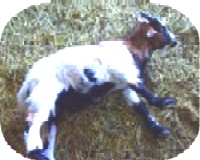
Pfaff Pfamily Pfarm Rambo “down” |
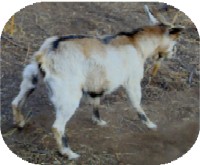
Triple-T Rosey "locked-up" |
The myotonia condition that causes these goats to stiffen and/or faint in no way affects their health or causes them pain. It is strictly a muscle condition and does not affect
their nervous system or their brain.
Each goat has a varying degree of stiffness, from those that are
consistently stiff, to those that are rarely stiff.
Myotonia congenital is a recessive
genetic condition, which means that if a doe or buck is bred to another breed of goat, the offspring do not faint. |
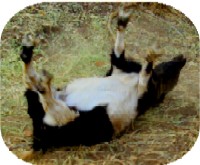
Triple-T Locket "play dead faint" |
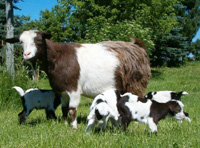
Danks Acres Oreo (Krissie)
Photo courtesy of Pfaff Pfamily Pfarm |
So, why are fainting goats such wonderful pets? Well, their genetic condition actually eliminates some of the negative traits (or what may seem to be negative traits by some) that other breeds of goats have.
Fainting goats are very easy to manage as they do not climb or jump well making it much easier to keep them fenced
in.
They are less vocal than other breeds of goats. If you stop to think about it, if you cannot effectively run away from predators, why would you announce to them that you are there? This is not to say that they are speechless. They just seem to save their “baa, baa’s” for when there is something to baa about, like dinner.
Myotonic does are
known to be easy kidders (give birth easily on their own)
and for being good moms if allowed to become fully sexually mature before their first breeding (at least 12 months old).
Their friendly mannerisms and
small to medium size make them great pets and companion animals. |
|
In addition to these qualities, the prolonged contraction of the muscles causes heavy muscling. Many
Boer and Kiko breeders will mate their does to a Myotonic buck to increase the muscle mass of their
meat producing goats.
The Myotonic goat is classified as a meat goat and is raised for meat by many ranches. However, here at Triple-T Ranch, we raises them for pets, breeding stock, and for showing.
These goats are not your average run-of-the-mill goats. They are very special and unique works of nature. Help us, and all of the other Myotonic goat breeders, get this wonderful, rare, and threatened creature off of the American Livestock Breed Conservancy priority list and back into the general population. |
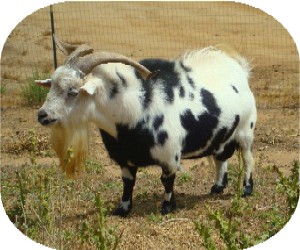
Quinton Ranch Rodeo Star
Triple-T's founding herd sire |
To learn more about this incredibly unique and rare animal, please visit the Fainting Goat Guild, International Fainting
Goat Association,
the Myotonic Goat Registry,
and The American Livestock Breed Conservancy web sites.

|